



I am always on the lookout for stories for Roland’s Travels and Notebook. There is a vast amount of interesting things on my own doorstep. I started the day looking for inventors born in Wiltshire, and I came across Henry Moule (pronounced Mole), born in the Wiltshire town of Melksham. I live only about six miles from the town, and this immediately peaked my interest.
There is another thing that drew me to write about Henry Moule and his invention. For many years, I have watched a YouTube channel, Living Big in a Tiny House. As the name implies, it’s about tiny homes where people have opted for a more simple life. Many of these homes are off-grid and have to deal with things like generating their own power and disposing of toilet waste. In the majority of the videos I have watched, the homeowners have a composting toilet, and that’s where this story of Henry Moule peaked my attention.
Henry Moule was born on 27th January 1801 to George and Sarah (nee Hayward). George Moule moved from London to Melksham before Henry was born. George was a solicitor and banker with an office in Lowborne, Melksham.
Henry obtained a BA at St John’s College, Cambridge. Shortly after getting married (1st July 1824), he became Curate at St Michael’s and All Angels Church, Melksham. It wasn’t long before he moved to Gillingham in Dorset and was appointed in June 1825 as Curate and in sole charge of St Mary the Virgin Church.
Another move followed in 1829 when, in 1829, he was appointed as vicar of St George’s Church in Fordington, at the time a village and now a suburb of Dorchester. It seems that Henry was not a popular vicar with the parishioners. He was known for his feisty sermons, in which he denounced the morals of the locals and the spiritual state of the church.
Henry turned his approval ratings around. Cholera was never far away, and there were two devastating outbreaks of the loathsome disease in 1849 and 1854. The village of Fordington was badly affected, and Henry worked extremely hard in caring for the sick and helping boil or burn contaminated clothes.
In 1861, Henry Moule produced ‘National Health & Wealth’, which was a twenty-page pamphlet. He wrote this in response to the disease, nuisance, waste, and expense caused by cesspools and water drainage. Henry didn’t like the way sewage was stored and moved in water. He had been working on a solution and invented a dry earth closet. A patent was taken out in May 1860, and in partnership with James Bannehr, formed the Moule Patent Earth Closet Company.
In effect, Moule produced what today has become trendy: a composting toilet. In the tiny homes that I have seen, these can cost from a few hundred pounds to over a thousand pounds, depending on how complex they are. Some of these toilets have small fans to help dry out the solid contents and push the air outside.
Do composting toilets smell bad?
One of the points most often made by those who have installed a composting toilet is that they do not stink. As long as men sit down to pee and the urine is kept separate from the faecal matter, there are no issues. After each use of passing stools, a covering of sawdust, coconut coir, or other suitable material is added. Moule’s system added dry earth. This helps dry the faeces, which is approximately 75% water, and adds carbon to the rich nitrogen of the waste for composting. Once the bin is full, the composting process can be carried on outside, ideally in a composting bin.
One manufacturer that seems to be very popular amongst tiny home dwellers is the company, Nature’s Head.
Henry Moule’s Dry Earth Closet
Let’s take a look at Henry Moule’s dry earth closet. The closet was made with a hopper that stored the dried earth and was released after ‘doing your business’ to cover the faeces. The floor slopes forward to separate the solids from the urine. Perhaps not so easy to use as today’s models with separate containers. The pictures below show the early model and an improved version made around 1875. Moule also produced variations on his original design, one of which had a mechanism like a corkscrew that mixed the dry earth with the excrement, helping it to dry out quicker, something found on many modern composting toilets.
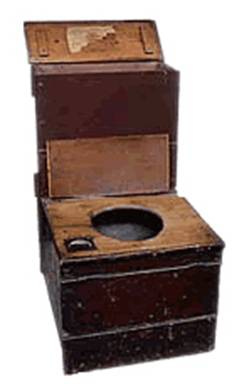
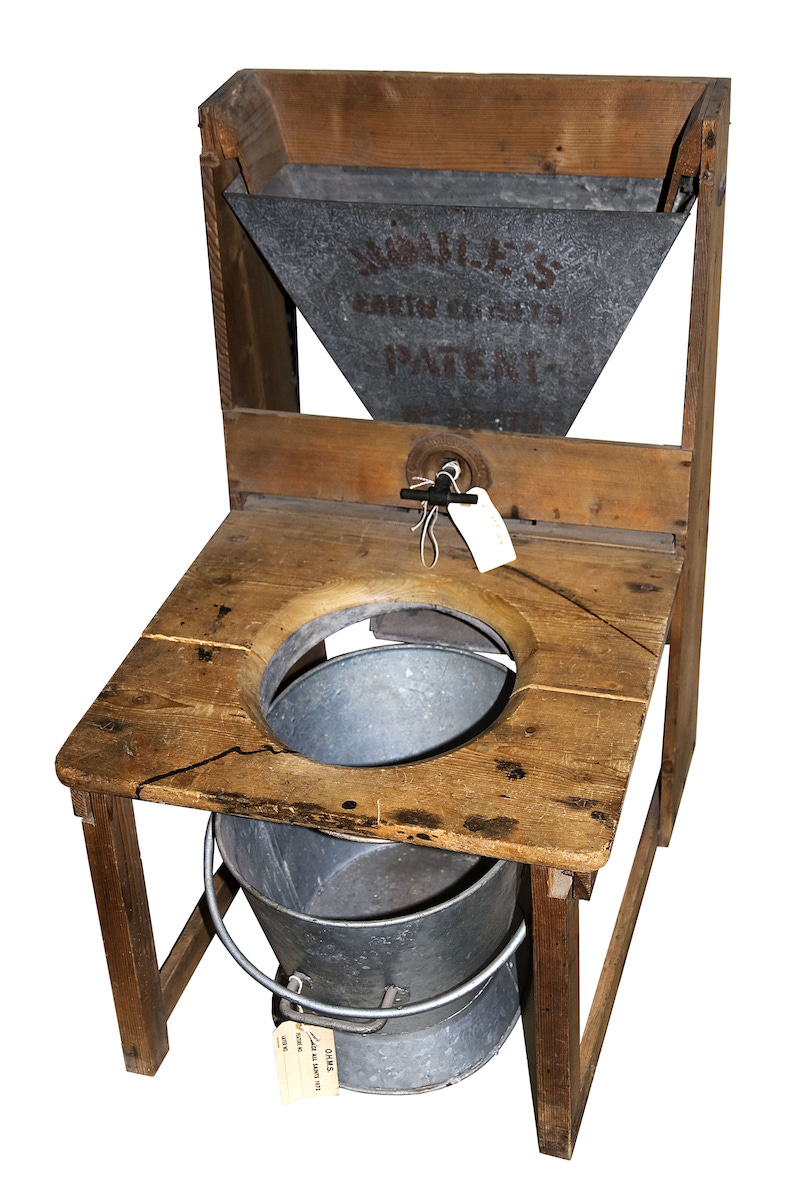
There is no doubt that Henry Moule’s Dry Earth Closet helped save lives and proved to be a very hygienic and safe method of dealing with human waste. Here are some reports:
The Field of the 21st November 1868, “…in towns and villages not exceeding 2000 or 3000, we believe the earth closet will be found not only more effective but far more economical than water drainage.”
The August 1st 1868 edition of The Lancet reported that 148 dry earth closets were in use at the Volunteer encampment at Wimbledon by 2000 men without any odour being produced.
There’s a lot more to the life of Henry Moule and he continually lobbied the government to take steps to improve the disposal of human waste. He campaigned by writing many pamphlets on the benefits of a dry earth system and the use of compost in agriculture. For Henry, such disposal was a win-win situation. What had been dangerous waste could now be used in an environmentally friendly way.
What would he think today of the rise in the use of composting toilets? I think he would be proud to see his design modernised with new materials, but the principle is still very much his work. Off-grid dwellers, van-lifers, and boat owners are taking full advantage of composting toilets. These toilets do away with those stinky chemical toilets that people hate to empty. Composting toilets and eventually the resulting compost don’t have any disgusting odours.
As our water systems become more polluted, maybe there will be more use of a composting toilet in the future. It might be old technology, but it works and doesn’t pollute the rivers and seas like we see today. They also save a vast amount of water that is used to flush away the waste. Thank you, Henry Moule, you did a great job!
Thank you for reading this story. If you haven’t subscribed yet, please use the subscribe button below. It’s always free to read all of my stories, with a paid option for anyone who wishes to help support what I do. Or you can use this Buy Me a Coffee link.

It's interesting how we think our progress of indoor plumbing as being advanced. In reality it is probably better for us all to have a more simple solution like this. Water is too precious a resource for what we're using it for.
We have overcomplicated many things!