

It was raining very hard outside and the wind was howling.
Storm Austen was keeping me firmly inside my home, and that was a perfect time to carry on research for ideas for stories for Roland’s Travels. With the click of a button, I found myself looking on eBay for anything of historical interest connected to Warminster, a town in Wiltshire. Often I find interesting old photos, usually postcards that can give me ideas on which streets or buildings might lend themselves to further research.
As I scrolled through the items, an envelope with a Victorian stamp caught my eye. It was posted from Edinburgh to Warminster in 1877 and it was the addressee that caught my eye. It was handwritten, which is not surprising as the first commercial typewriter was only produced a few years earlier.
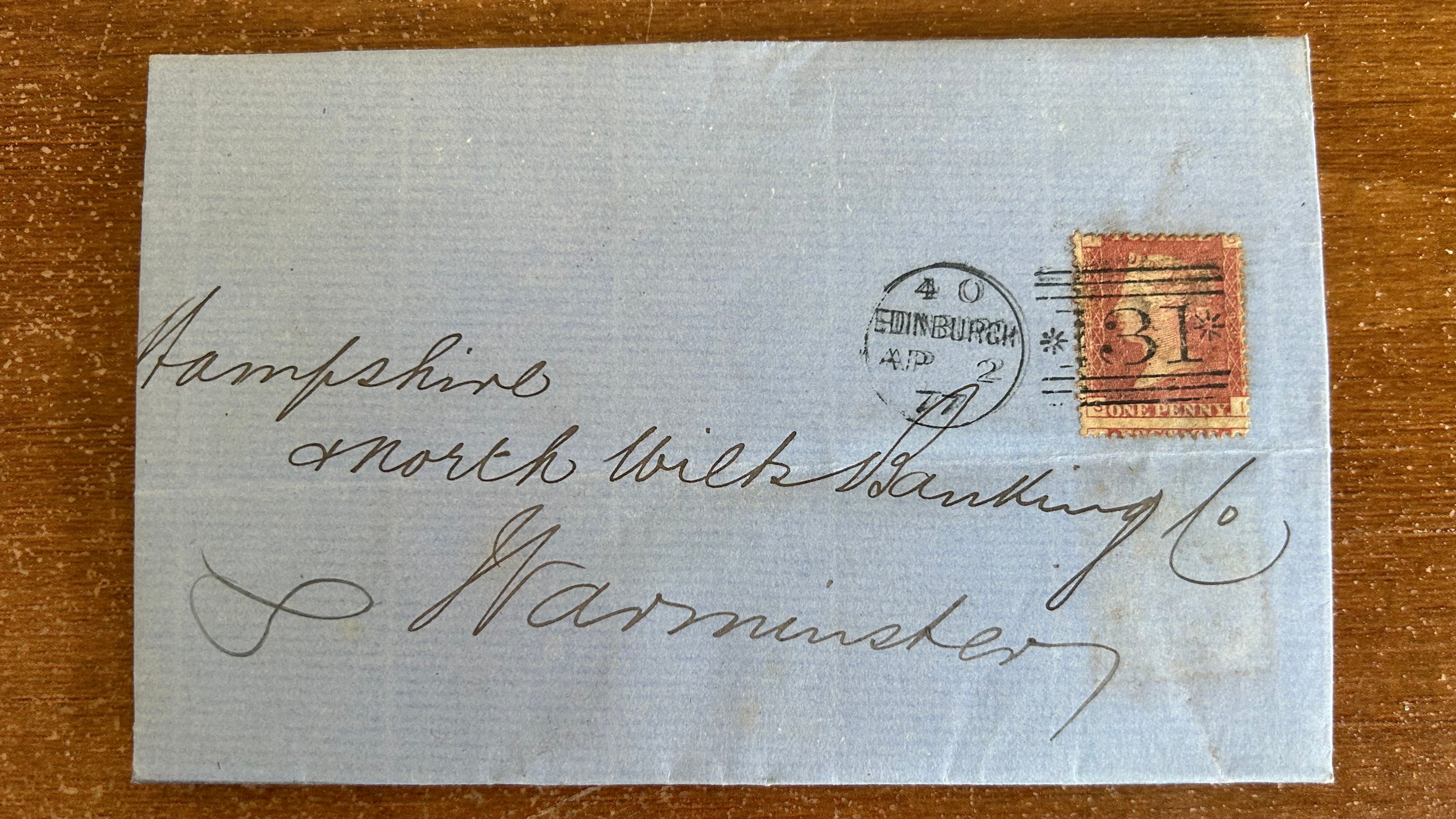
The envelope is addressed to Hampshire and North Wilts Banking Co., Warminster. No street address, but with the location in a small town and addressed to a bank would hardly be necessary back in 1877. This piqued my interest, and as the item was in an eBay auction with only a couple of minutes to go, I made a bid. I am pleased to report that I was successful, and you can see the photo below.
My first thought was, ‘Where was the bank located, and is the building still standing?’ More research required!
During the late 17th and 18th century there were many private banks, and the history of the Hampshire and North Wilts Banking Company is interesting. As is the case with many businesses, especially banks it seems, there are mergers and takeovers and name changes along the way.
The Hampshire Banking Company had its origin in Southampton in 1834. Meanwhile, further north in the county of Wiltshire, banking was growing. Founded in the late 18th century, a bank, Everett, Ravenhill & Company, opened in Warminster. Also, around thirteen miles north in the town of Melksham, was another private bank, the North Wilts Banking Company, which itself was formed from Moule & Co (pronounced Mole) which started in Melksham in 1792. I have written about a member of the Moule family from Melksham, the Reverend Henry Moule, who improved sanitation with his invention of the composting toilet.
The North Wilts Banking Company acquired Everett, Ravenhill & Co in 1860 along with Brown & Co, a bank in Marlborough, Wiltshire in 1866. By 1877 there were twelve branches of the bank, all in Wiltshire. They were: Melksham, Salisbury, Devizes, Calne, Trowbridge, Swindon, Marlborough, Bradford on Avon, Wootton Bassett, Corsham, Pewsey and New Swindon.
We now come to the year my newly acquired envelope was posted, 1877. The Hampshire Banking Company and the North Wilts Banking Company amalgamated and became, as the address on the envelope says, the Hampshire and North Wilts Banking Company. This name didn’t last long. After all, it doesn’t exactly roll off the tongue! Just a year later, in 1878 it was renamed Capital and Counties Bank, and by 1918 it had 473 branches across the UK. It was a London clearing bank, which is quite a prestigious thing to be. The Hampshire Bank had, in its heyday, opened a branch in London on the corner of Bishopsgate and Threadneedle Street, close to the Bank of England. The bank commissioned the building prior to the name change, and it was built in 1874–1876 and designed by the architect Theodore Knolles Green.
Lloyds Bank Takeover
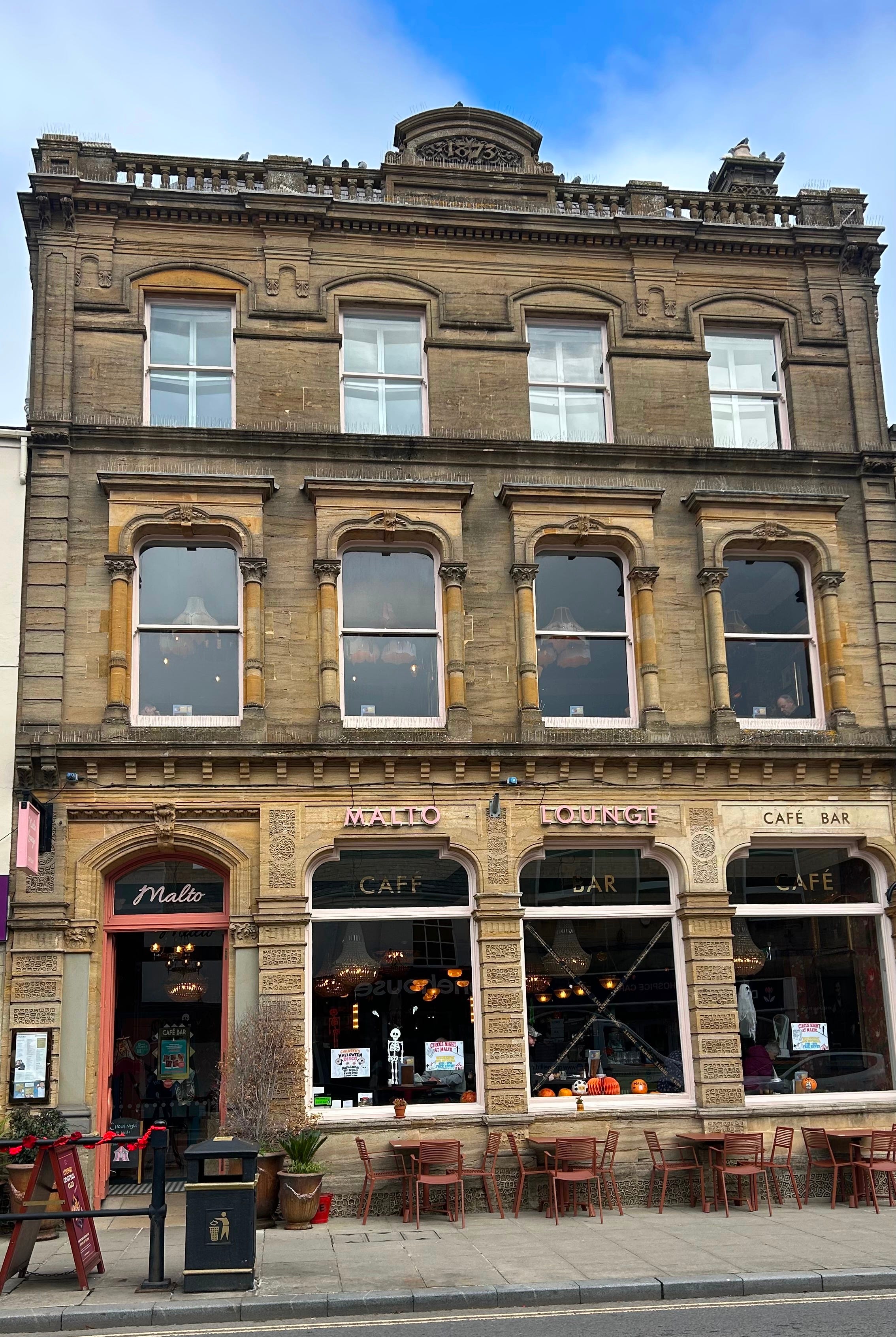
Our story now moves to 1918 when Lloyds Bank acquired Capital & Counties Bank along with many other smaller banks over that period. So where was our Hampshire and Wilts Banking Co branch located in Warminster? Well, I am pleased to tell you that the building still exists. Lloyds Bank kept the same building. It is 37 Market Place, Warminster. Like many banks, Lloyds have closed this branch and many of the others they took over in Wiltshire. Today the building is the Malto Lounge. The banks the Victorians built were magnificent purpose-built buildings or grand houses converted to bank use. Take a look at the building below, opened in 1873, the location of the destination of this envelope back in 1877.
I wonder what the contents of the envelope said? There is no need to wonder! This letter was sent in the old-fashioned way of writing on a sheet of paper and then folding it to form the envelope. The letter was then made secure with a wax seal whcih you can see on the reverse of the formed envelope where it was attached. The stamp is a Queen Victoria penny red and apparently plate 160.
My research tells me that the use of envelopes had come into fashion from 1840 as the cost of paper had come down, and by 1855 in Britain 93% of domestic letters were sent in an envelope. Thankfully, for us, there is no need to worry about the message being separated from the envelope. It would seem this bank was happy to stick to the traditional method of folding paper into what looks like an envelope. When I purchased this I only expected it to be an envelope, and so it was a lovely surprise to have a letter.
What was written in the letter?
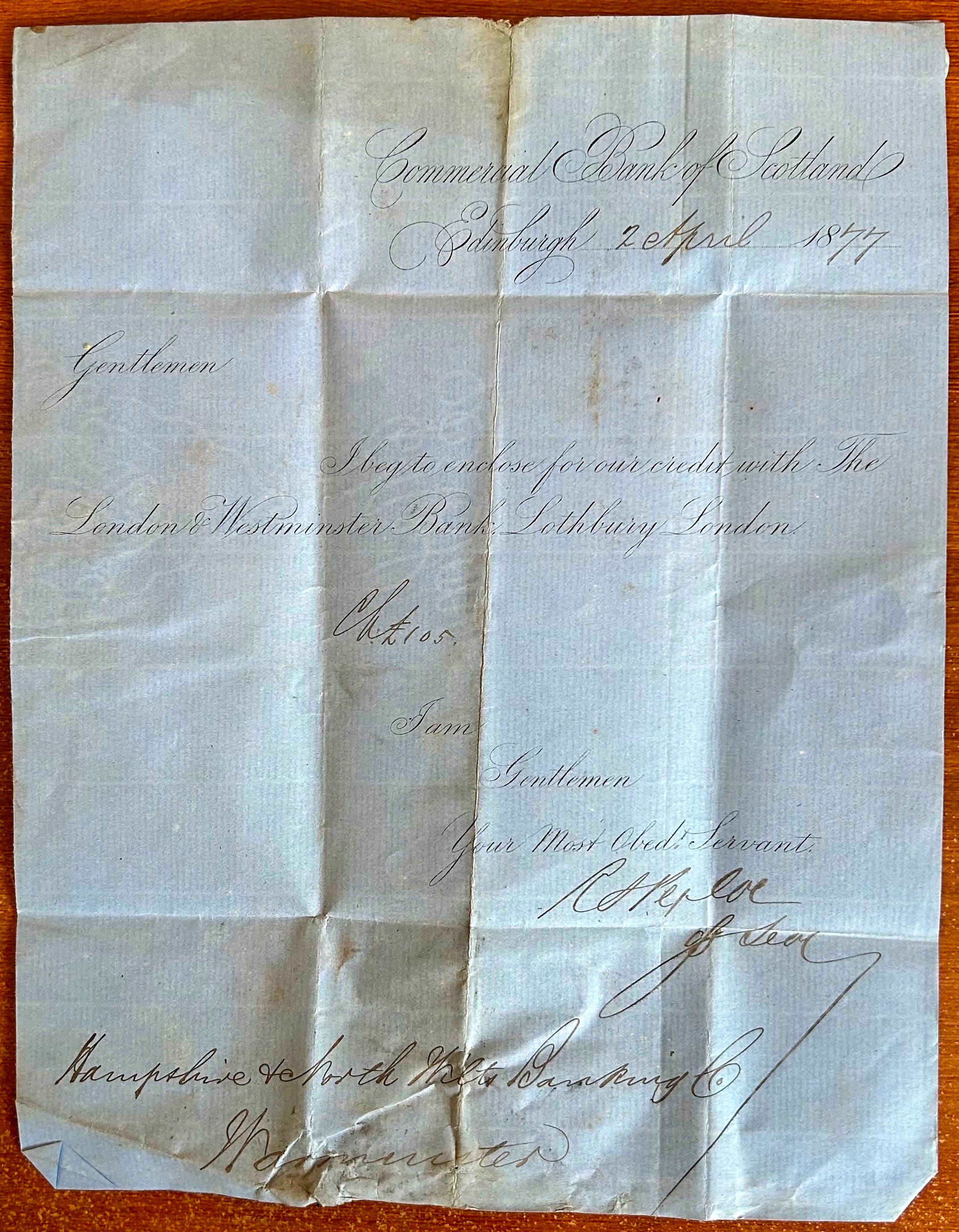
First, let me tell you about the paper. The paper before being folded was quite large and is of very good quality. The size unfolded is 41cm x 26cm which is folded in half, leaving a side that is pre-printed ready for use and the sender had to only fill in some details. You can see this in the photograph further below. When reading the letter, the size is 26cm x 20.5cm, just a little under A4 size.
The sender is the Commercial Bank of Scotland, Edinburgh (founded 1810 and by 1968 had become the Royal Bank of Scotland)
2 April 1877
Gentlemen
I beg to enclose for our credit with The London and Westminster Bank, Lothbury, London
Ch £105 (handwritten)
I am
Gentlemen
Your Most Obed. Servant
Handwritten signature
Hampshire & North Wilts Banking Co
Warminster (Handwritten)
Perhaps there was a cheque enclosed for the sum of £105.
The contents led me to look up the two banks, and I discovered that the London and Westminster Bank eventually became the National Westminster Bank. The London and Westminster was the first joint-stock bank to be founded in London in 1834. By 1838 it had moved to its head office, 41 Lothbury, which passes to the rear of The Bank of England in Threadneedle Street. The head office was rebuilt and made into a grand building between 1923–31 and is now serviced office accommodation.
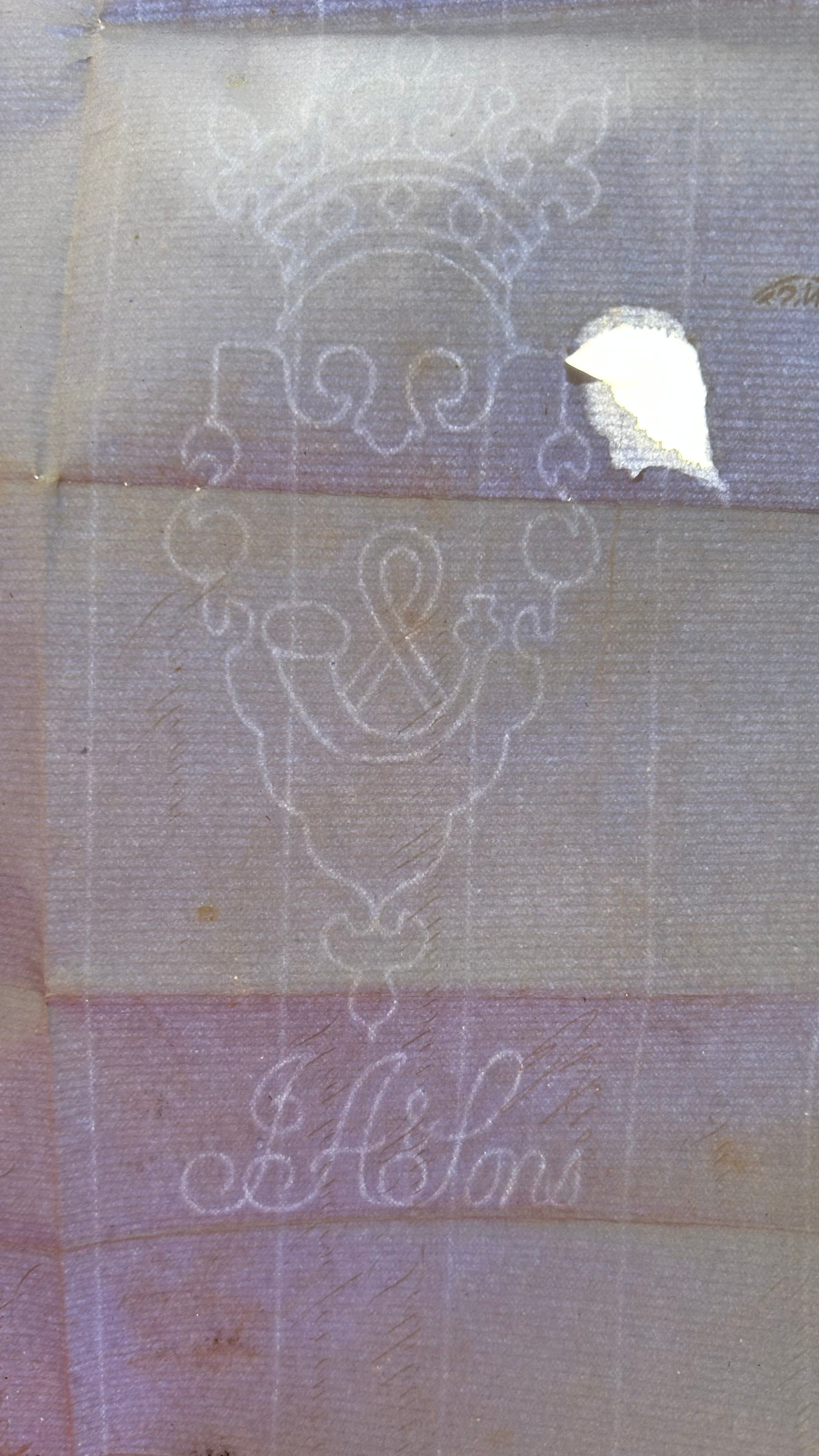
The letter has a watermark; a crest and company name, JA & Sons. I believe this to be John Allen & Sons, Stowford Mill, Ivybridge, Devon, who at the time were major producers of quality paper for letter-writing and gift wrapping. There’s a whole other story to tell from this watermark!
Finding one letter for sale just goes to show how much history there is when it comes to things that have been saved. In this digital age, there are fewer paper documents, and it will be almost impossible for a future historian to find such interesting items that can tell or add to a story from the past.
If you would like to own this letter, I have listed it for sale on eBay and with it I will provide a printed copy of this article. Click here to see the listing.
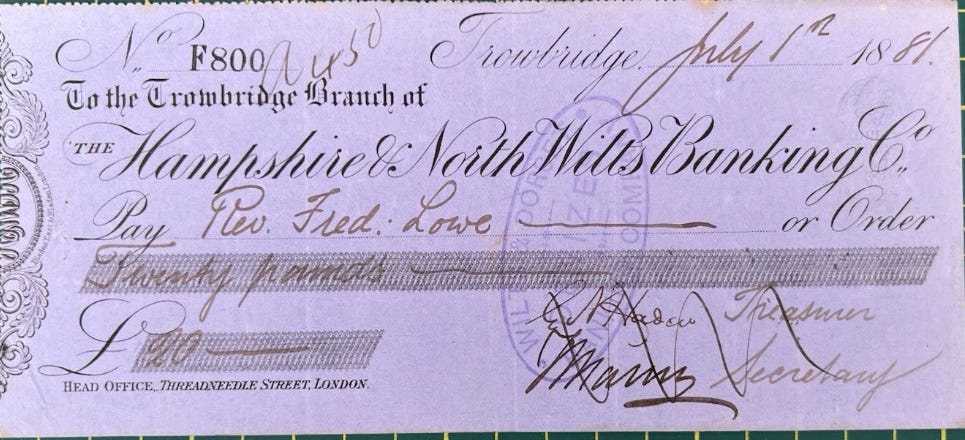
I did an online search and found photos of old cashed cheques from these banks. I have even found some for sale on eBay. See the picture below of a cashed cheque for the Trowbridge & North Wilts Banking Co., Trowbridge branch, dated 1 July 1881. This cheque was printed before the name change in 1878 to Capital & Counties Bank and was obviously still acceptable. The cheque is made out to the Rev Fred Lowe, and he has signed it on the back. It is for the sum of £20, quite an amount in 1881.
This has proven to be a fascinating story for me, and there seems no end to the directions in which I can go to find more interesting stories. Stand by!