

Police Constable Jones took out his notebook. Using his trusty ballpoint pen, he wrote down the name of the man whom he had stopped in the street. He made notes and recorded what the man said.

For years, police officers have relied on a notebook and pen. I am sure that most of us never give a second thought to the humble ballpoint pen, often in the UK called a biro. They are cheap to buy, and every household must have many lying around on desks and in drawers. Billions have been manufactured over the years, and every day it’s said that 15 million are sold around the world.
Thank you for reading. It helps a lot if you give the article a heart, share it or comment.
“The pen is mightier than the sword”, was first used by English author Edward Bulwer-Lytton in 1839. The availability of a low-cost pen has done much good. The fact that children and adults can obtain pens so easily, and that they can write even on cheap paper, has proven to be a mighty thing. Until ballpoint pens came along, and were cheap enough for anyone to buy, fountain pens, or before those, dip pens were the option of a few. The pencil has been around for some time, but of course, it is easily erased and therefore not suitable for legal documents, or anything where tampering could be a problem.
The first patent for a ballpoint pen was on 30th October 1888. It was registered by John J. Loud. He wanted a pen that, unlike fountain pens, could write on rough surfaces. He produced a pen that could do that, but it couldn’t write on paper as too much ink flowed out from it. There proved to be no viable commercial use for Loud’s pen, and the patent lapsed.
Many tried to build on the idea of a ballpoint pen, but failed. The problems they faced were the accuracy of the fit of the ball and the ink flow. If the ball was too tight, it wouldn’t turn smoothly, causing the ink on the paper to be a hit or miss affair. If it was too loose, the ink, which was the same as fountain pen ink, would pour out too fast and mess up the paper being used.
Moving on a few decades, and in the 1930s, Laslo Biro, a Hungarian newspaper editor, thought about how he could improve on the idea of the ballpoint pen and get it to work. He worked on the ink. His brother, Gyogy, a dentist who had a good understanding of chemistry, joined him. Biro noticed that the ink used to print newspapers was thicker than pen ink and dried quickly. Gyogy got to work and formulated an oil-based ink that would work.
Biro filed a British patent on 15th June 1938. He and his brother fled Germany in 1941 to Argentina. In 1943, he filed a new patent for a pen, and a friend, Juan Jorge Meyne, joined him in business. The pen was called the Birome, made up of his name, Biro, and Me the first letters of Meyne. It was not a cheap pen and would, in today’s terms, be like buying a luxury item.
Meanwhile, over in England, a British engineer, Frederick G Miles, licensed the rights from Biro to make a ballpoint pen. Miles produced aircraft among other things. The ballpoint pen proved useful to the Royal Air Force as fountain pens at altitude in unpressurised aircraft were prone to leak. Miles marketed the pen under the name Biro. That name has stuck in Britain ever since, and many people will refer to all ballpoint pens, no matter who made them, as a Biro.
After the Second World War, many companies started to produce ballpoint pens, and one was to emerge that would change pen ownership for good.
Over in France, in 1944, Marcel Bich and Edouard Buffard purchased an empty factory in Clichy, a suburb of Paris. They made pen holders and pencil cases. Later, Bich bought the patent from Biro for $2 million. He got to work and, using watchmaking techniques, designed a better process to make the small balls to fit in the pen.
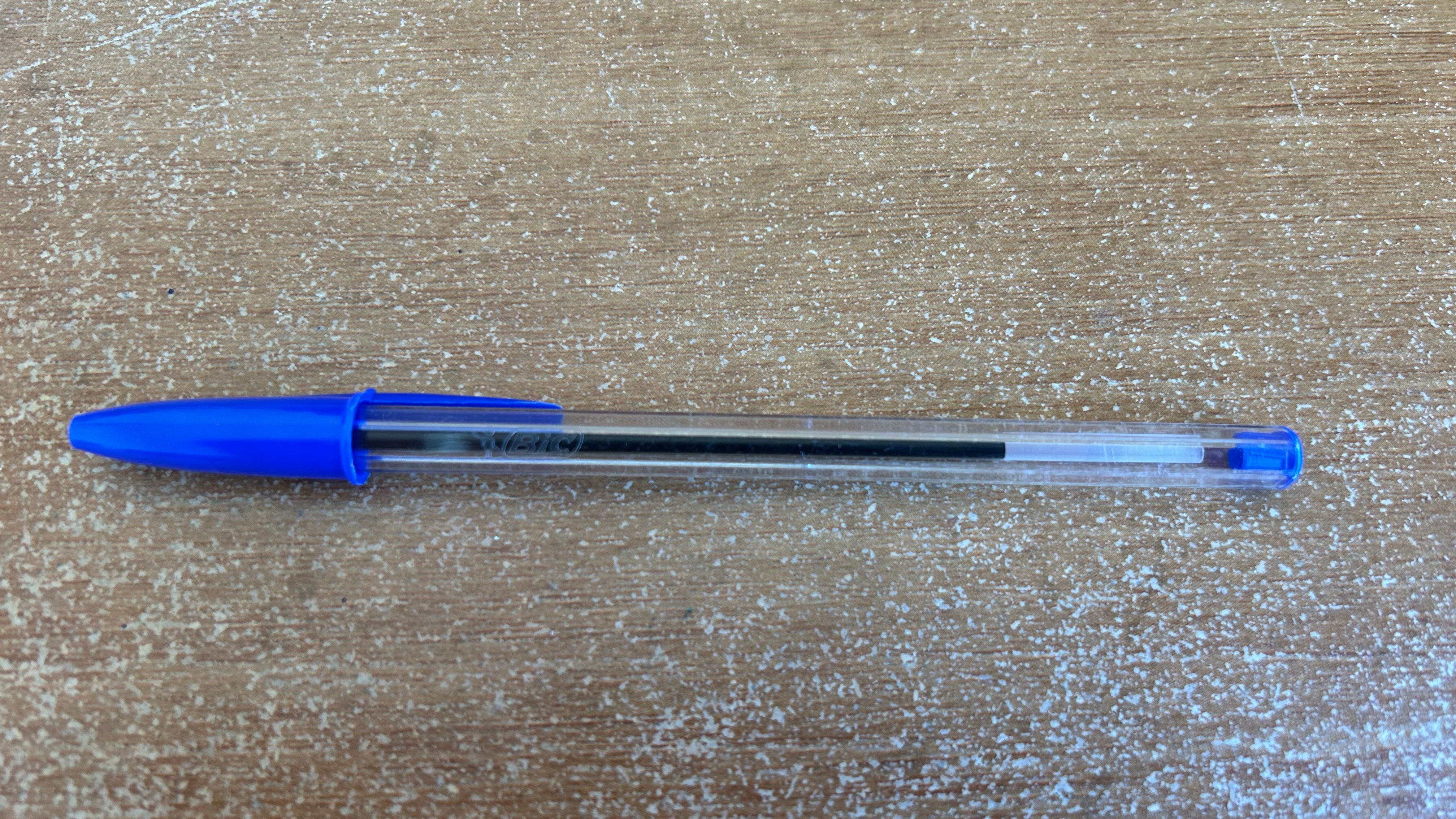
The Bic Crystal Ballpoint Pen
In 1950, the iconic Bic Crystal was launched at the time known as the Bich Crystal. In 1953, the ‘h’ was dropped from Bich. The pen was cheap to buy, even cheaper today as they cost a few pennies each due to faster production. Billions of Bic pens have been sold, many more than people alive. In September 2016, the 100 billionth Bic Crystal pen was sold.
The pen, with its clear barrel which allows the amount of ink remaining to be seen, the hexagonal shape which prevents it from rolling off your desk, and a useful cap, all make this pen attractive to buy. The barrel has a small hole that allows for the regulation of air pressure to ensure a steady flow of ink.
The Museum of Modern Art in New York City (MoMA) recognised the Bic Cristal’s industrial design by introducing it into the museum’s permanent collection.
There are many makes and styles of ballpoint pens available, some costing pennies to hundreds and even thousands of pounds. The quality of writing can vary, although it has to be said that the Bic Crystal writes very well. A pen with a little more weight can make writing less tiring than a pen that needs to be pressed harder on the paper. Pens that cost more will also use refills, which means that the pen can be used for many years, or even more than a lifetime, for a quality pen.
Sadly, with the proliferation of keyboards and smartphones, many rarely use a pen, even in schools. It has been noted that writing only on a keyboard is detrimental to our ability to learn and remember. In some countries, children are going back to handwriting their work and the use of keyboards has been greatly reduced. Let’s see if other countries take note. I am sure many will.
I really enjoyed this read. I'm starting a pen company and am actually making a ballpoint pen that's meant to not go in the junk drawer lol. So it's nice to see someone showing an appreciation for this marvelous design.
Great piece Roland and it brought back a memory of the early 1960s when learning to write at school. The preference was for pupils to use an ink pen, either dipping (still the days of ink pots in desks and the ink monitor) or for those who had them, fountain pens. However some children asked if they could use ballpoints to which the teacher would agree after testing that the ink ran smoothly and didn't 'blot' the paper while being used. Something you would never see now but back then I guess production processes weren't perfect for cheaper ballpoints.