


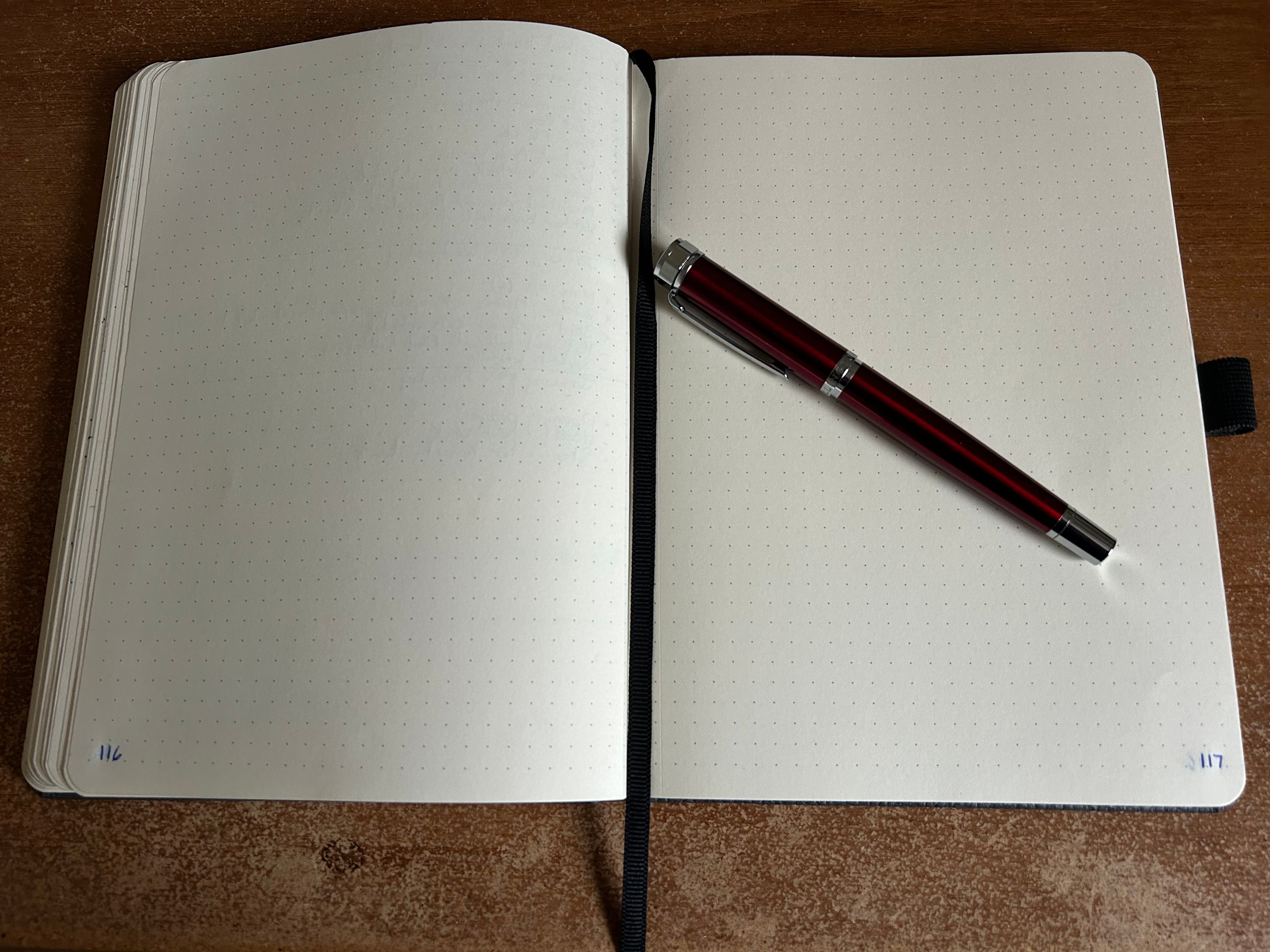
During 2023, I made great efforts to begin to reduce my reliance on digital tools. A search online showed me that many others too were trying methods that would help them to do the same. I noticed that journalling was becoming very popular, and a proliferation of notebooks had come onto the market to meet the need.
My research took me to online articles and YouTube videos of those who journal. It appeared that many of the popular videos were made by journalers who were very artistic. Their journals were full of illustrations, calligraphy, and other arty methods that are just not me. For me, I just want a method of having something simple and a little bit more than a diary.
I came across videos explaining a method which aroused my interest—a Bullet Journal.
What is a Bullet Journal?
The concept of the Bullet Journal1 came to the fore when Ryder Carroll launched this method in 2013. A book, The Bullet Journal Method, was published in 2018.
The Bullet Journal is a method for recording actions, appointments, to-dos, plans, feelings, and more in a simple way. It essentially uses bullet points and as little as a few words to help organise our lives and record our thoughts. It’s flexible enough to be adapted to suit our needs. It’s not designed for those who want to write pages every day in a journal, stick in photos, and fun stickers. Keeping it simple is key and takes away the pressure some feel who are not natural writers of their thoughts and feelings.
A bullet journal can be started at any time. It doesn’t have to be regarded as a diary with a January 1st start date. A notebook can stretch over a year. I did actually commence my Bullet Journal on January 1st 2024, that’s because I decided to try this method only a few days earlier. My Dingbats A5+ Notebook2 is a little over halfway completed and so 2026 is rolling on in the same book and I expect it to be full around October time. If it were almost full, i.e. under a month or two space available, I would probably have started a new notebook. There are no rules on that. A notebook after completion can be labelled with the date range.
I have included a video, by Ryder Carroll, further below, who is demonstrating the set up for you.
The first steps to take when you want to Bullet Journal include purchasing a notebook that you will enjoy using and will stand up to being used on a daily basis. If you, like me, prefer to write with a fountain pen3, ensure that the paper is fountain pen friendly.
If the notebook has pages that are numbered, the next task isn’t necessary. Number all the pages so that the book is indexable. The first two or three pages should be set aside for an index.
I created a Future log. This is a section of six boxes for six months spread over two pages. Anything major that is planned goes into the log. I don’t add anything mundane in these sections.
At the start of the month a page is set aside and each line is for one day with the date and first letter of the day listed. e.g. W1, T2, F3. You might prefer 1W, 2T, 3F. At the end of each day, a short highlight is recorded to remind me of something that happened on that day.
The next page is headed Tasks & Notes. On this page for that month any plans or notes to be remembered are added as they occur.
Next comes the daily log. The page starts with the day. January 1st - Wednesday. Each line is a bullet line and starts with a code. I tend to start this at the end of the previous day so I can add things I need to be aware of or do and will add to it during that day.
The symbols used are as follow:
. Task (add the dot to to the centre height of your letters. Constraints here place it on the base line.
— note add any note you wish. It might be a note from a conversation, maybe you have made an order online and keeping a note to show when is useful, and so on. A note can be anything that is not a task or event.
o event/meeting
< Migrate to future log. (Turn the dot into this symbol and the same below) i.e. The task needs to be done during a future month.
> Migrate forward to the next day
<< Moved from the journal to an app. For example, you might move this to a reminder app.
* Immediate priority The asterisk can be added before the symbol at any time if a task becomes urgent.
= Write down how you’re feeling, your emotions.
When a task is completed, write over the symbol with an X. If at the end of the day anything still needs to be done, then decide what to do. Either leave it and make sure you go back over your days regularly or use the migrate symbol and deal with that accordingly. If a task needs to be done the next day, I migrate and add it to that day’s tasks. If anything no longer needs to be done, strike it out with a line. At the end of the month, look back and if there are any uncompleted tasks, make sure you deal with them.
Other pages
Pages for tracking things can be created. I have a page to record the books that I have read. A page can be started anywhere and at any time in your Bullet Journal that is suitable for you. Some journalers use fitness trackers, weight trackers, finance trackers, and business goals and results. It’s as flexible as you want it to be, but for me I want to keep it simple and not try to cram in too much. More detailed needs could be added to another notebook specifically for that purpose.
In the video below, Ryder Carroll explains the basics of setting up a Bullet Journal in the way I have described.
I have enjoyed using the Bullet Journal method and will continue using it. I still use additional to-do lists when helpful. For example: In my Bullet Journal there might be a need to go shopping. I will add that as a task, but everything required on that shopping trip will be on a separate list. The same is true of a DIY task. I recently decorated my hall, stairs and landing. That is a task listed in my Bullet Journal, but all the tools and materials required would go onto a list elsewhere. For this I use a section in my Filofax.
Do you use a Bullet Journal? Let me know in the comments how you are getting on, and please feel free to share any tips.
Thank you for reading this story. If you haven’t subscribed yet, please use the subscribe button below. It’s always free to read all of my stories, with a paid option for anyone who wishes to help support what I do. Or you can use this Buy Me a Coffee link. Please feel free to leave a comment.