

The Filofax Yuppies!
Back in the 1980s, it was a common sight for the young, upwardly mobile (aka Yuppies) to be carrying a Filofax. It became a sign of being well-organised and successful. That look was replaced by the mobile phone, even though at first they were the size of a brick.
However, the Filofax (other brands are available) was not new to the 1980s. It had been around for decades and used by many in all sorts of occupations. Where did the Filofax get its start?
Ring binders, as we know them, were invented in 1886 by the German Friedrich Sonnecken. He also invented the necessary hole punch to make the system work. However, his invention and a couple of other binder systems before his were all about the storage of documents or the ability to change pages in them, reducing the need to print a complete new book or manual.
It was in 1910 when a Canadian engineer, J. C. Parker, invented a loose-leaf system for adding a diary, notepaper, addresses, and so forth. Now, people could keep important information in one place, with the ability to add or remove pages as their needs changed. He founded the company Lefax and sold what we now call ‘personal organisers’.
The History of Filofax
Over in England, Lefax came to the attention of businessmen, Colonel Disney, William Rounce, and Posseen Hill. They founded the company Norman and Hill Ltd. on 6th December 1921. A number of years later, the company was renamed Filofax and produced its first personal organiser in 1930. The name Filofax comes from the term File of Facts.
Filofax bought Lefax in October 1992 and phased out the name Lefax by the late 1990s. At the time of purchase, Filofax had outgrown Lefax and was selling ten times more than its American rivals.
The Filofax organiser proved to be worth more than its weight in gold when, during WW2 in 1941, Filofax’s London office was destroyed. The secretary, Grace Scurr, made use of her Filofax. Every night she took it home, and it contained key information about customers and suppliers. That information saved the company at this dreadful time and allowed it to continue to operate.
With the advent of electronic organisers, and eventually the smartphone, perhaps one would have thought that a paper-based system like Filofax would have been killed off. Today, though, there is a resurgence of users for the Filofax, including me. Technology has its place, but it has its own issues. Many are increasingly tired of being tied to technology that is demanding of their time as it contains so many distractions. We all know that just a glance at a smartphone can lead to clicking on apps that we never intended to view.
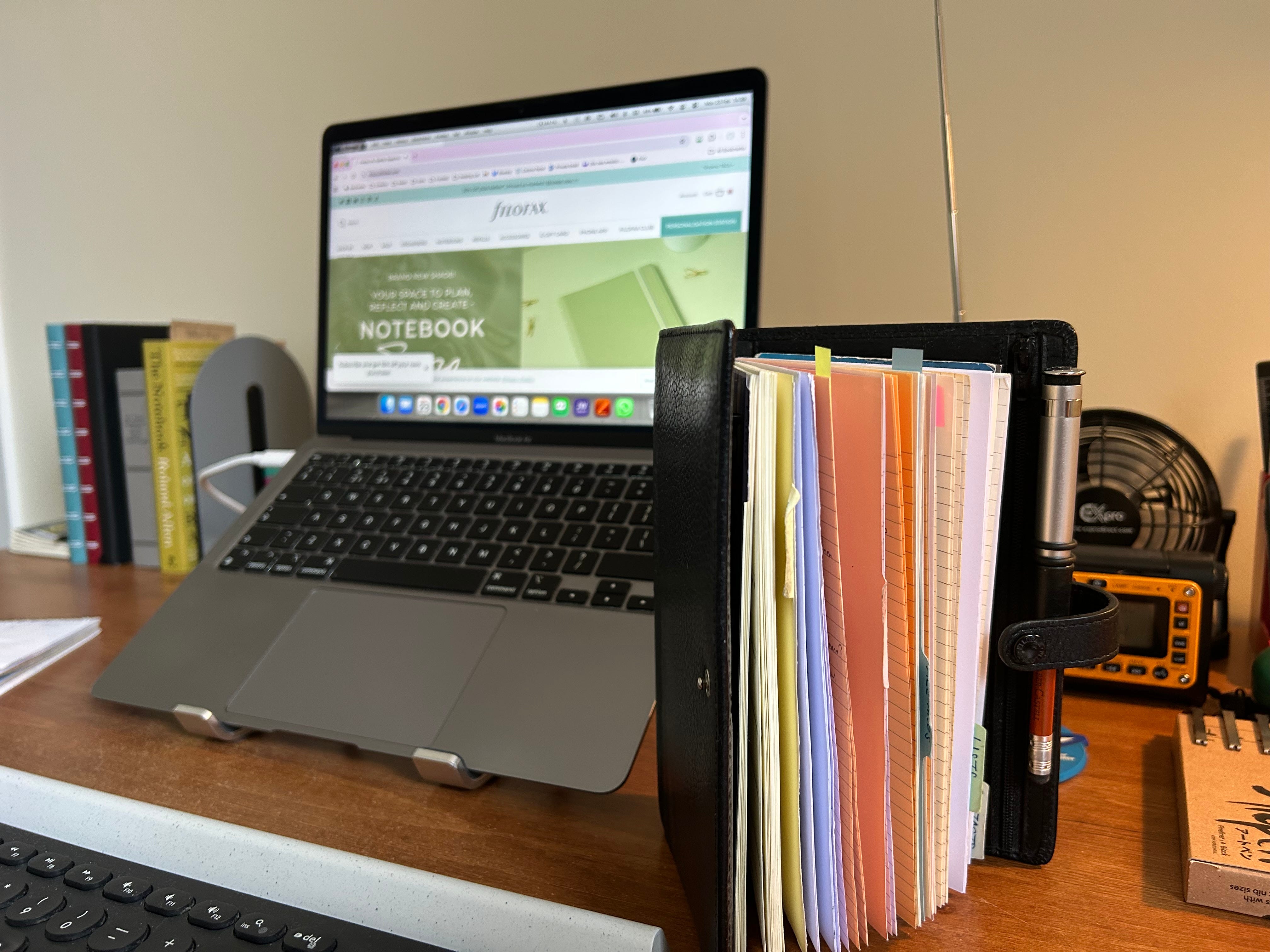
A paper organiser, like a Filofax, does not cause such distraction. It also works without batteries and never needs an operating system update or replacing because the manufacturer no longer gives support.
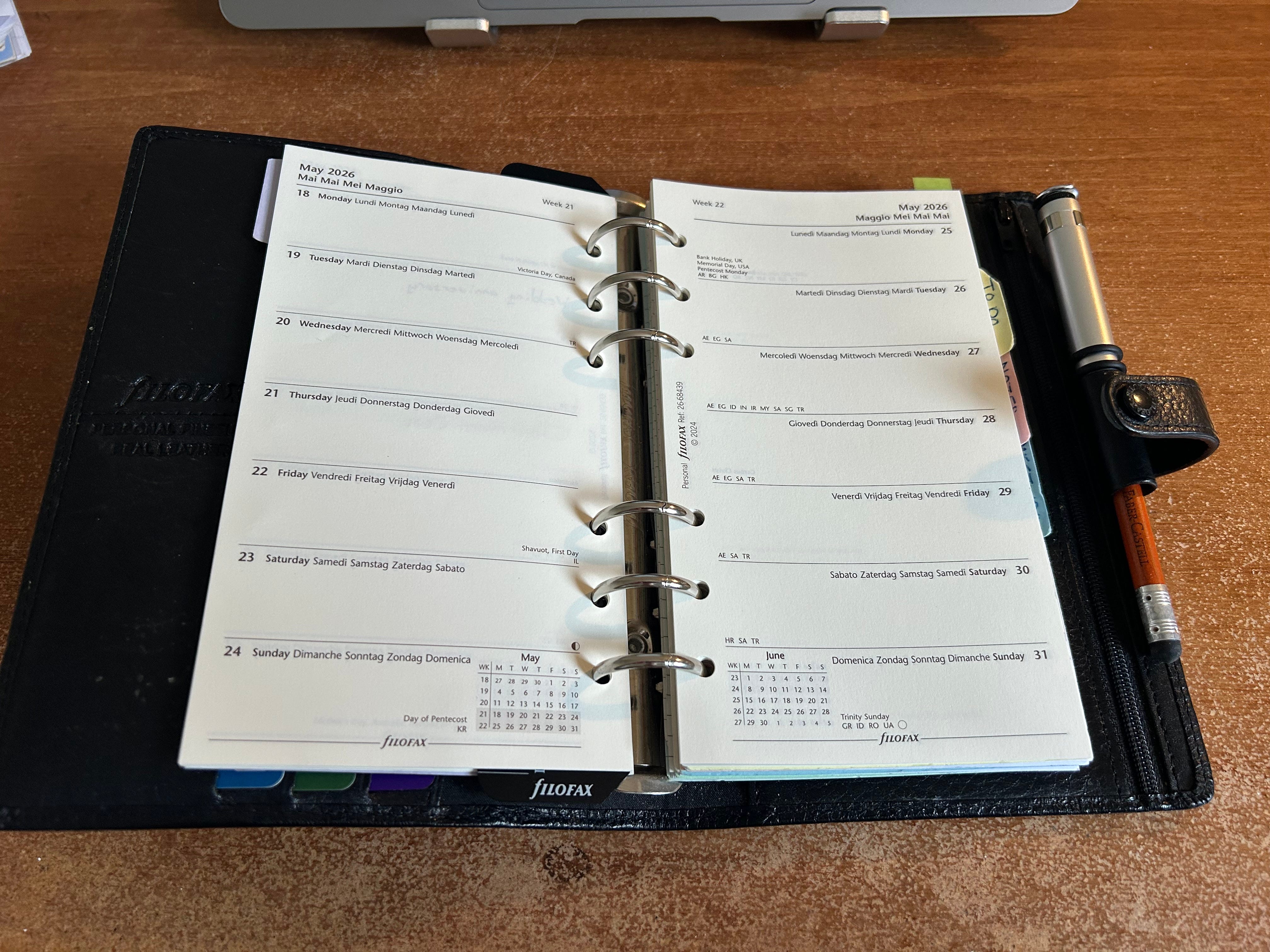
I love to use my Finsbury Filofax, which is personal size. A personal-size organiser has pages which are 95mm x 171mm (approx 3.75 x 6.75 inches). It’s probably the size that comes to mind when people think of Filofax. You can make three pages from an A4 sheet of paper.
Filofaxes are available in a number of sizes from the tiny Mini and slightly larger, Pocket, through to A4. Many options of pre-printed pages to insert into them can be purchased, such as diaries, to-do lists, finance planners, maps, and more. Of course, you can also make your own pages, and a search online will point you to those who produce templates that you can use. A website I visit a lot is Philophaxy1, where there is a lot of information on how to use your organiser.
In my Filofax, I have a diary which is a week to a page, a To-Do section, a section which contains blank pages where I write any notes, a section where I record or prepare for any meetings, next come lists which are anything that needs to be listed excluding to-do items. Finally, I keep some key contacts, just in case I were to lose my phone. These are all separated by divider cards.
The beauty of a personal organiser is that you make it personal to you. It is a file of facts and has the ability of helping you to plan your time. YouTube has many videos made by those who use them and they will give you some ideas if you’re new or want to get back into using a Filofax. Everyone has different needs. For example, some will require a diary with a page for each day, as they would have more appointments to track than I do. A larger size, A5 or A4, might be better for the busy office manager, executive, or those running their own business.
There are other brands of personal organisers. Some are made with cheap plastic covers, others very expensive leather. Keep in mind that cheap rings will fall apart. Please note that even with quality rings you should always open your rings using the two levers at the top and bottom of the ring mechanism. Don’t be tempted to open the mechanism by pulling the rings, as this can strain them preventing them from closing tightly. Filofax2 has a range from under £25 to over £100. Of course, the price is dictated by size and the cover material. A leather one should last you many years.
Do you use a personal organiser? Let me know about it in the comments. Please feel free to share any tips or tricks.
Thank you for reading this story. If you haven’t subscribed yet, please use the subscribe button below. It’s always free to read all of my stories, with a paid option for anyone who wishes to help support what I do. Or you can use this Buy Me a Coffee link. Please feel free to leave a comment.

To visit Philophaxy - click here
Comeback? Was it ever out of style? (Or did I blink and miss a few decades??)
I’ve used one ever since I went to work for the Board of Education in Leicester Diocese. I was 36 then. I still prefer them to electronic things.